



A corrupted woman is soaked in sin and gradually torn from her soul. Her purity that was once unscathed is now an unbounded commodity. Piece by piece, she is dismantled until the only thing that’s left is flesh and blood. From the ashes of unadulterated youth, now rises something else. The transformation from beauty to grotesque is immediate. A woman is either a maiden or a witch. A sin or a sinner. An unknowing victim or an unholy perpetrator. The existence of both is morally reprehensible. Here we have the scripture of ye old storytelling embedded in every culture, every time, and in every form.
Nonetheless
...
every artifice, every duality inherits a line that exists to challenge it. A tempo-spatial blip where white melds into the black – where Angels mingle with Demons, where grotesqueness is beauty, where tragedy births empowerment, where witches ARE women – explodes with a forgotten force. That coalescing blip takes form in Belladonna of Sadness (Kanashimi no Belladonna): a powerful visual enigma that mesmerizes with bizarre aestheticism and erotic storytelling (one that many will probably write off as a “deep” hentai and in the process, dismiss the work so passionately fueled by the revolutionary spirit that drives all provocative art).
Belladonna is the third and final installment in the Animerama series (adult-themed films) conceptualized by Osamu Tezuka, but due to his early abandonment of the project, it was sought through (in 1973) by Eiichi Yamamoto and produced by Mushi Production. Adapted loosely from the non-fictional musings in La Sorcière by Jules Michelet, Belladonna follows the vicious downfall of a young girl named Jeanne, and thus, her metamorphosis. Even though Belladonna takes influence from Michelet’s book, it is not a literal re-telling. The novelty of Michelet’s work, however, should be noted. La Sorciere attempted to trace the rebellions against feudalism and Medieval practices that subjugated women and peasants. Riddled with folklore, fairy tales, and religious theory, the book opened a new sympathetic vision towards the oppressed, and what eventually manifested into “witchcraft”. Belladonna is a tale about oppression, but also about revolution. What starts off as a fatalistic chain of events steeped in sexual violence and tradition, morphs into a darkly, disturbing tale of empowerment (featuring Satan symbolized as an ever-growing penis, lots and lots of other phallic imagery, and intense psychedelics visuals).
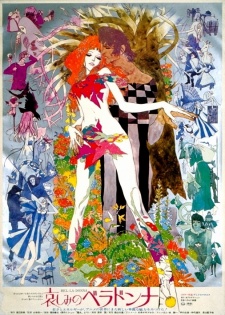
The aesthetical direction in Belladonna is unlike anything I’ve ever seen. Sequences of stylistically-independent paintings that are tied by motion. Styles include Klimt-influenced artworks where the female body is the everlasting focus. The only place where precision in detail matters is on Jeanne, and partly her husband and abusers. Following in the symbolist tradition, many embodied the elements of Decadence. These paintings were full of lurid, exploitative objects that were flourishing with mystical context. Decadent art called for transgression and taboo and expressed them through dreamlike visual poetics. Belladonna adapts this with acuity. Abstract, expressionistic paintings also take hold here. The use of placement, distance, object and how they come alive, both with color and shape all reveal this. There are scenes that are built entirely on geometric progression. The painting starts at one point, transforming into a set of shapes that blooms into the eventual scenery. Kaleidoscopic backgrounds and mural-stoned-faces swell up the screen, while continuous mutations and distortions keep the atmosphere full of psychedelic vigor. It’s like a never-ending party in the 60s. The art-style is intensely experimental and frequently disorienting. The styles and influences here are endless: watercolor paintings, ink-stencil portraits, sketchbook graphics, bubbly cartoons, and the list goes on – of all the various art-styles contained in this film. Even though the film ranges in the kind of techniques it employs – many of them being direct contrasts to one another – it never hiccups, not even once. The continual change in style becomes equally as important for the story. It’s a story with centuries of sociopolitical turmoil, unveiled through centuries of art evolution on canvas. And the best part is that it’s always fluid and always flowing.
Consequently, Belladonna's art is demanding, bold, highly erotic, often-etched-imminently, and absolutely unforgiving. The shots move ever-so emphatically; scenes feel as if being drawn out right then and there. The horror here transposes itself not just as a genre, but a state, an endless feeling that seduces the senses while suffocating the mind. There are scenes comprised of simple shapes, lines intersecting, and splashes of unending red and black that are more horrific than most horror films attempting to be anything more than a gore-fest nowadays. The film functions in directional panning waves that slide from painting to painting, with minimal movement and sparse dialogue. One of the most laudable aspects was the use of motion. Films, at a very fundamental level, need to master the skill of motion; to be able to capture the mobility of ideas in a visual format. In the same way that sometimes silence speaks louder than sound, stasis expresses visual ideas more potently than systematic movement. It’s animation revised: unbridled by traditional sequential movement, materialized through motion on canvas. Stasis then becomes as important as motion. Belladonna proves this with its delicate and deliberate staging and execution.
Now really, what is Belladonna about? The aesthetics tell it all. The “how” is infinitely more valuable than the “what”. Even then, there is still plenty to bask in, narratively. Belladonna is a purely visual experience, but isolating the narrative is worthwhile. Reconnecting with the earlier synopsis, Belladonna tells the seemingly unfortunate tale of Jeanne. On her wedding night, as custom dictates, Jeanne and her husband Jean must receive the okay from the baron (through paying ridiculous monetary “gifts”). As they cannot meet the high demands set by the Baron, Jeanne is subjected to ritualistic rape by the Baron and his house of ghastly courtiers. From then onward, Jeanne continues to suffer at the hands of her time, repeatedly violated by those in power and by circumstance, she finds herself in an old-fashioned predicament: compromising her humanity. It’s not original in its premise. Tales of religious persecution, power, and transformation almost always follow a similar formula: striking a deal with the devil. Therefore, the story unfolds on a two-fold: first, on the degradation of humanity and second, on the revival of it.
What sets Belladonna apart is its perspective and thematic subversion. The apparent importance of religion, tradition, and all these concepts that arise from scripture of society all take a backseat for Jeanne’s place in the world. She becomes the singular point of relevance amongst cosmic indifference, where she comes before the judgments of the world. This is crucial for the second half of the story and the ultimate, conclusion. The perspective here is refreshing, in the ways many modern fairy tales are, especially those with a female focus. The one that immediately comes to mind is a collection of short stories by Angela Carter titled The Bloody Chamber. These tales are of the revolutionaries — the nontraditional, and those unaligned with the religious depiction of “woman”–, where through the crevices of preordained evil and sacrilegious, arises positivity in the form of empowerment and transformation. These are far more important than redemption or “survival”. It’s history, art, and humanity revisited but with the scales tipping the other way. Thus, the devil becomes a tool. Evil becomes a means to an end. The deal becomes a means to an end. The body is shown to be purely material and the spirit/soul as mere propaganda. Things that held the greatest amounts of meaning become empty remnants in the face of ultimate transformation. The most important point is that woman and witch remain synonymous. This isn’t a movement to destroy humanity, but to revolutionize it.
Jeanne makes the deal and becomes a witch. Yet, she doesn’t seek revenge in the old-testament sort of horrific way. She sets the way for the townspeople and all those that violated her to find hell in their own manner, whether it’s through hedonism, paganism, or partaking in 24/7 orgies. The Black Plague is also a thing, here (and the origins are hilarious but terrifying). Jeanne helps those struck by the plague (using various plants and concoctions) and becomes their savior. With her “help”, the villagers willingly walk on their personalized road to perdition. (Belladonna is a nightshade plant. The root was used to make medicine, but the leaves and berries are deadly. It’s named after Venetian ladies who used it to dilate pupils for striking appearances). Jeanne assumes her rightly place as the Belladonna who in the wrong doses, proves to be lethal and insurmountable. As Angela Carter reformulates the heroine/woman in modern fairy tales, “Like the wild beasts, she lives without a future. She inhabits only the present tense, a fugue of the continuous, a world of sensual immediacy as without hope as it is without despair,” we find ourselves seeing Jeanne reflected in the very same words. Jeanne descends into –what we perceive as– madness, a form of clinical hysteria from any angle. Despite that, there is something far deeper settling in her reverie: “The girl burst out laughing; she knew she was nobody’s meat.” And that very Carter-ian depiction becomes the absolute state of Jeanne.
Even with the inevitable “end” of Jeanne, the story holds true to what actualized empowerment entails: continuation. It doesn’t end with the body.
Experiencing Belladonna is very much like falling down a bottomless rabbit hole. A visceral drop where one experiences each grain of the twisted earth, swallowing wholly, their entire state of being. The dive isn’t measured. It’s freefall so fast, one almost feels like they are suspended in air, motionless. During those moments, every sensory receptor is attuned to an unknown, unearthly frequency. It’s a film designed to enthrall the senses and heighten all temporality. The kind of thing people do drugs for. Spectacularly, it achieves this for every second of its runtime. Enter this with an open mind. Belladonna knows for she is woman and witch, and both exist here simultaneously.
Alternative Titles
Synonyms: Tragedy of Belladonna
Japanese: 哀しみのベラドンナ
More titlesInformation
Type:
Movie
Episodes:
1
Status:
Finished Airing
Aired:
Jun 30, 1973
Producers:
None found, add some
Studios:
Mushi Production
Source:
Book
Theme:
Historical
Duration:
1 hr. 27 min.
Rating:
R+ - Mild Nudity
Statistics
Ranked:
#39692
2
based on the top anime page. Please note that 'Not yet aired' and 'R18+' titles are excluded.
Popularity:
#3231
Members:
61,084
Favorites:
880
Available AtResources | Reviews
Filtered Results: 44 / 47
Sort
Your Feelings Categories 
Oct 28, 2018
A corrupted woman is soaked in sin and gradually torn from her soul. Her purity that was once unscathed is now an unbounded commodity. Piece by piece, she is dismantled until the only thing that’s left is flesh and blood. From the ashes of unadulterated youth, now rises something else. The transformation from beauty to grotesque is immediate. A woman is either a maiden or a witch. A sin or a sinner. An unknowing victim or an unholy perpetrator. The existence of both is morally reprehensible. Here we have the scripture of ye old storytelling embedded in every culture, every time, and in every form.
Nonetheless ... 
Aug 15, 2016
Overview:
My city's only arthouse theater decided to play this 1973 anime movie recently. I went with a couple buddies and it was...an experience. I will now try explain my mixed feelings on this rather unique film. Background: This movie is sometimes called "the lost Tezuka masterpiece" although Osamu Tezuka actually left the project quite early in production. Kanashimi no Belladonna or "Belladonna of Sadness" was written and directed by Tezuka's longtime friend and collaborator Eiichi Yamamoto. Yamamoto worked with Tezuka on Astro Boy and Kimba the White Lion, as well as writing Space Battleship Yamato, the first Space Opera anime. Belladonna of Sadness is an X-rated ... 
Jan 28, 2019
Spellbound in a whirlwind of love, sex, desire, and disaster, Belladonna of Sadness is a blistering wound of emotions and vices. The nature of sin and excess; the act of wanting too much without understanding the cost. A cautionary tale of indulgence as showcased by an unnamed kingdom positioned in the Middle Ages. The unfortunate recipients of which are Jean and Jeanne, a couple young in love in a world far too cutthroat to accept the purity of their union. Their honeymoon, a nightmarish event, forever tainted by the cruel actions of an aristocrat drunk with power. Deflowered and battered, Jeanne, a victim of the
...
Sep 27, 2015
And the award to the most underrated anime of all time goes to a movie produced and realised in 1973, as part of a trilogy by the Manga God, Osuma Tezuka, who leave the project. Kanashimi no Belladoona is amovie that the 99,9% of the anime fandom never heard any about. It's really difficut to found it on internet, and that's without subtitles.
But it's a shame. Anime creators like Kuhiko Ikuhara, Utena and Penguindrum's creator, has admitted the influence of this movie. So, why is this film so unknown? First of all, it's not a typical movie. It's an avant-garde movie, something you will notice just ... 
Feb 24, 2010
This is nothing groundbreaking, nothing that will change your world, but it is a fun little psychedelic trip. The few iconic scenes alone, such as her rape early on, leave enough that it is enjoyable even if it is a bit lacking in substance.
The art here is interestingly animated. The colors are always interesting to watch, and the animation mostly manages to be coherent despite the psychedelic nature. It is not always especially fluid, and I think that is what it has the hardest time balancing in a way that is totally watchable. I liked the art the most when the fluidity was best, but ... 
Feb 25, 2026 Not Recommended Funny  Informative 
Rape Porn. Skip.
It draws you in with beautiful art, composition, and music, only to keep showing abuse over and over again in that same “beautiful” style. It tries to be something it’s not. It’s nothing but the glorification of sexual violence — not for the sake of the plot, not for character development, but simply the creators wanted to show it. A waste of not only your time, the character designer and all of the artists working on it but also my energy that is being ragebaited to write this review. Story is your average man going "women = sorrow = artistic value up by 1000", we never ... 
Oct 18, 2023
Psychedelic shitshow that sexualises sexual violence and abuse towards women. I think I made a mistake watching this because Osamu Dezaki was involved and Tatsuya Nakadai voice acted in it, lesson learnt. It's supposed to be about sexual liberation but the art is crude and brutally exploitative. The creator of this movie were probably a bunch of men with no idea the nuance of the experience of woman and their sexuality. Really unique art and watercolours used, really some of the frames were gorgeous. But tacky and gaudy execution.
I rarely write reviews, i just hate this movie so much i had to write one. 
Oct 24, 2025
The rest of these reviewers need to go back to primary school to develop some critical thinking skills.
This film is a masterpiece in every sense of the word. The story it portrays takes the typical "witch" folklore and turns it on its head. What's more, the breathtaking original soundtrack takes the viewer by the hand, and guides them through each of Jeanne's defining moments. The audience gets a representation of the emotions she's experiencing at the hands of her village, and has no choice but to feel empathetic towards who she chose to become in order to protect herself. Other reviewers will tell you that the ... 
Jun 30, 2017
[SPOILER FREE REVIEW]
First of all, I apologize for the bad English. Kanashimi no Belladonna is what happens when hentai becomes art. The erotic scenes, here, aren't just sex. Belladonna of Sadness is a real journey through the misogynist universe of Christianity, exploring every single detail of the suffering of women in a sexist society in the most beautiful way that is possible. Story: 10/10 The story isn't some Texhnolyze-like complex plot, but it's as sensitive and brainy as. The story follows Jeanne, a christian woman in a truly medieval European scenery (not like Nanatsu no Taizai or Meine Liebe, where there's no representation of the poor people's suffering ... 
Jul 2, 2022
"The Belladonna of Sadness" is quite literally that - sadness. It's an estetically pleasing and abstract movie about a woman who lost everything dear to her due to her tragic fate and bad decisions in life.
If this kind of artistic movie were to be made today, most ordinary anime fans would absolutely hate it. Why? Because of the way it was made. It is almost completely made of moving drawings. In my opinion drawings are amazing though and really express the characters. Another thing that surprised me is the use of singing in telling the story. I don't usually like that kind of thing, but ... 
Jan 4, 2025 Not Recommended Funny
Genuine shite, skip this one. If you thought this movie had anything meaningful to say about its themes (rape, sexual abuse, etc.), you'll be disappointed, it's just torture porn the whole way through. Good music, but that's about it. The art is nice, but relies way too much on stills. Hated it so much everyone who worked on this is on my shitlist now, and I will personally judge anyone who recommends this to me
This might be the single worst movie in human existence, no joke. Is your fun in life watching someone get raped, then sexualized in the same breath? If so, then you'll ... 
Feb 2, 2013
I am seriously shocked that this movie has such a low ranking. This film is more of an art film than a japanese animation film -ok, I guess you noticed it from the beginning of the movie-, thus, you better stop ranking this film according to the usual way of giving a score to an anime. This film certainly lacks of a deep story, and the character development is quite poor, but don't be mislead cause this film wasn't meant to show a great story. The animation and somebody other technical characteristics are what wey are supposed to put our eyes on, and if.somehow you've
...

Apr 7, 2022 Not Recommended Funny
This is basically a moving picture, but also not. Sometimes the animation is very good and sometimes it looks like the creators just gave up and just have stills. The art is mostly the only good part, but then there was no need to make a film, just make a bunch of paintings... the music was alright. I do praise the art but it really feels like Jeanne only has two facial expressions, which is odd when it juxtapositions her empowerment/orgasm and her humiliation/rape.
Mostly the film feels gratuitous with its violence against women. There is no need for so much rape, murder, and brutalization of ... 
Aug 9, 2016
Loosely inspired by Jules Michelet's Satanism and Witchcraft, a fictionalized history of medieval witchcraft in Europe, Eiichi Yamamoto's cult anime Belladonna of Sadness strikes a perfect balance between midnight-movie enchantment and arthouse sophistication. The plot follows two recently married peasants, Jean and Jeanne (Aiko Nagayama and Katsuyuki Itô), as they deal with the aftermath of Jeanne's rape by a local baron (Masaya Takahashi) and his henchman by right of prima nocta. Jeanne eventually makes a Faustian bargain with Satan (Tatsuya Nakadai), who appears to her in the guise of a playful demonic phallus, which initially gives her vast social power, but ultimately breeds tragic consequences
...
May 23, 2017
This is an odd one, and I fell asleep for a bit towards the middle. Basically, an experimental animation about a woman who finds liberation through sex and inspires a revolution among the people by showing them to indulge in and accept their sexual desires. The problem is that doing so is combined with her accepting a devil penis, so indulging in sexuality is also connected to evil symbolism. Eventually, the patriarchy comes and ends the party and some pictures of women revolutions are shown to let us know that it's meant as an empowering film. If it's supposed to be empowering, why have her
...

Sep 30, 2023
Don't be tricked by a pretty face and what sounds like an interesting plot description; this movie is dull as paste.
You'd think with such harrowing plot points that the story would gripping and intense but the way its told is so unbearably slow and with such pretentious self aggrandizing that even the most dire circumstances become grim monotony. The art can be incredibly beautiful in snapshots but those snapshots are sparsely sprinkled through very minimally animated sections, infinitely looping scenes that go on forever, and outright still images. You'd really get the whole art experience of this just looking at a collection of screenshots. I'd honestly ... 
May 10, 2024
Based on the Novel, La Sorciere by Jules Michelet.
Also a disclaimer, This is an X-rated film that children should steer clear from. Let me preface by saying that this is The most unique and weird movie I've ever seen. Why that is you ask? Simply because it's filled with trippy acid visuals, A very novel and psychedelic approach to storytelling that I've never seen and it actually has minimal animation too. What I mean by that is most of the movie is just pictures that convey stuff. Yet I still think this movie managed to engage me as a viewer and I was not bored ... 
Dec 18, 2017
Can good art be made in bad taste?
Garish pastels, painted in splotchy water colour; violent pornography devoid of any traditional semblance of eroticism; an overbearing psychedelic soundtrack; still images in lieu of fluid animation. Belladonna of Sadness is a weird movie. The film, known as Kanashimi no Belladonna in Japanese, is probably more renowned within arthouse circles than it is with animation buffs, and it's easy to see why. This is not a feel good nostalgia-fest a la Ghibli or Disney. This is - in the purest sense - adult animation. The film revolves around Jeanne, a peasant woman. Early on, Jeanne is gang raped by her village's ... 
Jun 13, 2023
Provacative, surreal, and psychedelic, this is a film unlike anything I've seen before. The artstyle, sometimes muted, washed with watercolor dripping down the screen, and other times loud with vivid reds and greens that pop out at the viewer, is as beautiful as it is haunting. The animation, minimal at best, is slightly choppy but surprisingly very fluid during very specific scenes. It all feels purposefully done, as if to make those scenes stand out even more than the others. The music also serves a very large role, other than the instruments helping to convey the tone of the scene, often the singer will serve
...

Aug 22, 2018
I was intrigued to watch this , hearing the studio apparently went bankrupt producing this. Well, that and the beautiful art. But would I recommend this to a fellow anime lover? No.
Apart from the beautiful watercolor art, the story lacks character. Maybe that's what it was meant to be, when we stare across the walls of art gallery , we do not know half of the story displayed. Rather it evokes strong emotion according to our persona and past. While movies can be a great medium to be sad, happy, inspired, scared- the one thing it should not be is stressful. Watching this ... |


